October 16, 2026
How to Record Surf Guitar at Home Without a Huge Room
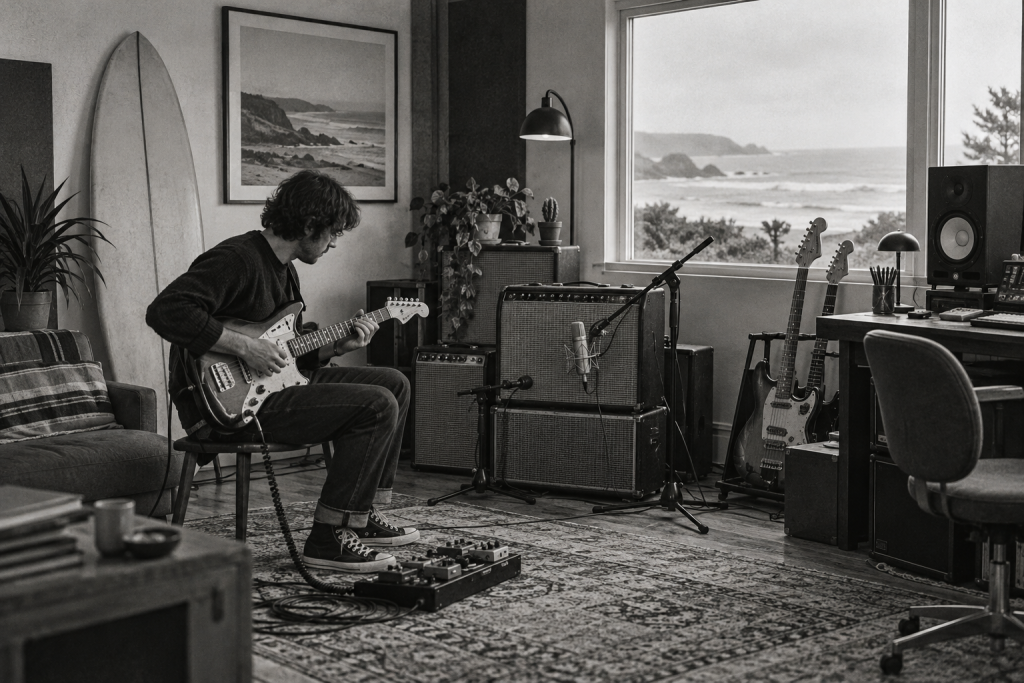
The first surf thing we ever recorded in this room was a mistake. We had a Jazzmaster plugged into a little practice amp, a single dynamic mic pointed at the grille because that’s all we owned, and the whole take was bleeding into a closet door we’d forgotten to close. It sounded terrible in the most useful way. It taught us that the room is not the enemy. An untreated box is. Those are two different things, and telling them apart is most of the work when you’re cutting surf guitar at home without a proper live space.
Surf guitar is strange because the sound people love is often the sound of a big, wet room, but the playing wants the amp pushed. Those two facts fight each other in a bedroom. You can’t crank a Deluxe Reverb at 4 to get the amp working without waking the neighbors or exciting every parallel wall in the place. So the trick isn’t to build a huge room. It’s to fake the space at the capture stage and keep the room itself out of the recording as much as possible.
Get the amp out of the equation first
Before we touch a microphone, we deal with the amp. The short version: a small modeling amp or a load box with an impulse response will beat a loud tube amp you can’t push. The amp market has spent the past fifteen years reorganizing around exactly this problem, with compact amps from 5 to 30 watts built specifically for home use, many of them with built-in effects and app-controlled presets. That’s the modern reality. You can get a convincing edge-of-breakup tone at conversational volume now, and the surf reverb that used to require a physical outboard tank and a loud amp can live in a pedal or a plugin.
We usually track surf clean-ish with a touch of grit through a small modeler or a low-wattage amp pointed into a corner, not at a wall. Aiming into a soft corner, or draping a heavy blanket over the amp and mic together, tames the first reflections that make a small room obvious. It is not glamorous. It works.
If you have a real tube amp you love and refuse to part with, a load box is the practical way to keep it in the room. The amp sees a speaker load, you get a line-level signal, and you apply the cabinet character afterward. No volume, no neighbor complaints, and the neighbor-avoidance part matters because volume is the thing electric guitarists deal with constantly.
Mic choice is where the surf tone actually lives
Here’s the part we’d push back on if we were reading this in another blog: expensive mic into a cheap interface is still the better trade. A better microphone through a modest interface will usually sound better than a budget mic through a premium one, because the mic shapes the raw sound more than anything downstream. Spend there first.
For surf specifically, we don’t want one flavor. We want contrast. A dynamic mic close to the grille gives you the bite and the attack, rugged and warm. A ribbon adds that dark vintage tilt that sits beautifully under heavy reverb, rolling off the top so the spring splash doesn’t get glassy. If you have a condenser, use it further back as a room/ambience microphone, but only if your room is worth capturing. In our small room it usually isn’t, so the condenser stays on the pedalboard or gets rejected outright.
A useful test: put three mics on the same phrase and listen back after piling on spring reverb. Surf is reverb-forward, so a mic that sounds lovely dry can turn brittle once you add the wash. Judge the mic in context, not solo.
Build the room after, not before
This is the shift that made home surf recording viable for us. Capture tight and dry, then manufacture the space in the box. Spring reverb is the signature, and a good emulation gets you the drip and the splash without a physical tank humming in the corner. For the wider, washy stuff, a convolution reverb loaded with a real space, or a plate, gives you the “big room” your actual room can’t.
Here’s where a trick borrowed from film sound earns its keep. You can take a short, dry close-mic signal and feed it to a longer reverb, even a reverse reverb, to build an ambience that never existed in your room. People do this with all kinds of found material, and the lesson holds for guitar: creative decisions made under constraint, like building space after the fact instead of hunting for the perfect room, often produce more distinctive results than a premium chain ever would. Your small room is a constraint. Treat it as one you can design around.
A quick capture checklist
- Aim the amp into a soft corner or cover amp and mic together to kill early reflections.
- Close-mic with a dynamic for attack, blend in a ribbon when the part calls for an older, softer finish.
- Track dry. No reverb on the way in, so you can shape space afterward.
- Keep input peaks well under clipping, with headroom to spare.
- Save reverb for the mix, where you can dial the spring and the room separately.
What about the room itself?
You do not need to soundproof a bedroom to record surf guitar. You need to stop the room from stamping itself on every take. A few moving blankets, a rug, a bookshelf, anything that breaks up parallel surfaces, will do more than a piece of gear. So will tracking at the amp, close, and refusing to let the mic hear the whole room.
The corollary: don’t chase an expensive ambience mic in a bare room. A clean interface and some basic treatment will beat a fancy microphone in an untreated space, because the mic is faithfully capturing the problem. Fix the problem first.
The other thing? Play to the room’s limits. Surf is built on twang, tremolo picking, and that staccato run. Those translate at any volume. The big, slow, reverb-drenched chords are the ones that beg for a cathedral. If your room can’t give you a cathedral, build one after the take and nobody will know the difference. Surf reverb is a feeling as much as a space, and a good spring plus a plate on a dry close mic gets you most of the way there.
The take that started this whole thing, the one with the closet door creaking? We re-cut it last month, close mic into a ribbon, dry, everything wet added in the box. It sounds like a room we’ve never set foot in. That’s the trick. You don’t need the room. You need to not let the room you have ruin the take, then build the one you wanted. Surf was always a home-recording genre at heart, small amps, cheap reverb, a garage. The gear just finally caught up to the garage.