October 18, 2026
Fender Tone Master Pro Reverb Review: One Room, One Amp, No Pedals
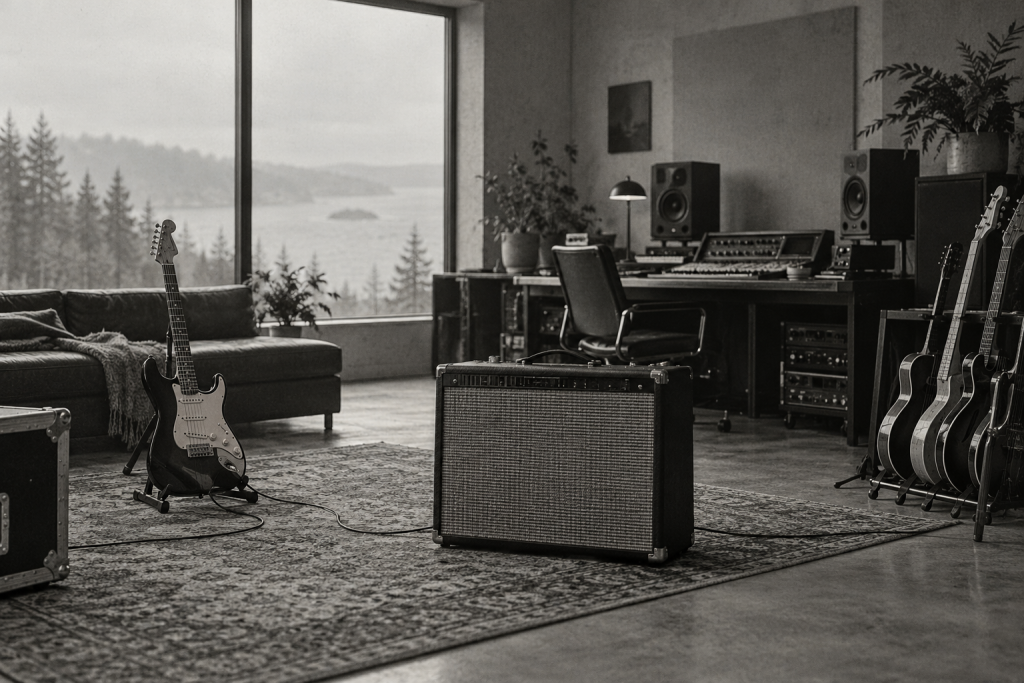
The Tone Master Pro has been sitting on the floor next to the desk for three weeks now. Not in the rack, not patched into the interface. Just there, on the rug, a guitar cable trailing across the room. That placement is the whole point of this piece, really. We didn’t set out to compare it against an amp sim or a plugin chain, we set out to see whether a floor unit could replace the habit of reaching for a mouse every time a reverb needed adjusting.
Our room is small. Twelve by ten feet, one treated corner, a couple of surf tunes tracked in there over the years, a worship set recorded last spring, the odd Hawaiian-flavored instrumental we keep threatening to finish. The Tone Master Pro is Fender’s modeling floor unit, and the reverb side of it is what we wanted to live with for a while. One room, one amp, no pedals. That was the brief.
What the reverb actually does
The reverb section isn’t a single algorithm with three knobs bolted on. Fender has loaded it with a spread of models covering the spring, plate, hall and room families, plus a handful of the older Fender amp spring tanks that a lot of us grew up hearing on records without ever knowing it. That last part matters for what I do here. A lot of the surf material we love runs on spring reverb out of an outboard tank, and a good model of that sound is hard to fake, because the drip and the splash depend on a physical spring behaving badly. The Fender models get the character close enough that we stopped thinking about it after the second take.
The control layout is straightforward. Pick a type, set the decay, adjust the mix. There are deeper parameters if you want to dig, but the default mapping is calibrated well enough that you don’t have to. That calibration is the quiet triumph of the unit. Compare it to a hardware piece we’ve used, the little Orange Outlawd ES3 Ed Sheeran signature amp, where the entire front panel is three controls: Volume, Reverb and Shape. Reviewers noted that approach works because those parameters have been calibrated properly, and that’s exactly the lesson here. A small number of well-tuned knobs beats a big number of badly-tuned ones every time.
The one-amp experiment
We settled on a single clean amp model for the whole three weeks. No switching, no snapshots chasing a different tone per song. Just one clean platform running into the reverb block. The idea came from an argument we keep having with ourselves about hardware and commitment. When you lay down a take from a real machine, that performance is locked in. You’ve committed to a pass, and that commitment lets you move forward instead of fiddling forever in the DAW. A modeling floor unit can either reinforce the fiddling habit or break it, depending on how you set it up.
One amp, one reverb, no pedals breaks it. We tracked a surf thing in the style of the instrumentals we keep coming back to, a slower worship-leaning piece, and a slack-key-flavored sketch. The amp model held up in all three, and the reverb sat behind the notes rather than on top of them. When we wanted a tighter room for the worship tune, we swapped the reverb type rather than reaching for a plugin. The change was audible in the room within a couple of seconds. No latency, no screen.
The tactile thing
There’s a reason we keep coming back to gear with knobs on it, and it’s not nostalgia. You develop muscle memory with a real machine, the way a guitarist knows their own neck. The interaction becomes instinctive, and that physical relationship turns the tool into a familiar bandmate rather than a shelf of samples. Turning a knob out of curiosity and finding something unexpected happens far less often on a screen, where we tend to stay on the beaten path or just load a preset. The Tone Master Pro has enough physical controls that this kind of accidental discovery still happens. We found a plate setting by accident while reaching for the mix knob. Kept it.
Where it gets in the way
The screen is the weakest link. It’s serviceable, but the workflow is not as fluid as the hardware suggests, and we hit a few moments where we lost track of where a setting lived. We’ve seen the same complaint leveled at Line 6’s Showcase mode on the Helix Stadium, where the reviewer admitted getting lost among the cues they’d placed. This is the recurring tax on floor units with big screens: the tactile promise and the menu reality don’t always line up.
We also hit the display issue that’s common to the category. Bright room, angled floor unit, glint on the glass. At home it’s fine, on a stage it would need some thought.
- The default reverb types are strong but the deeper parameters are less inviting than the front-panel mapping suggests.
- Editing on the unit is slower than editing on a laptop, so plan on doing your deep work in the editor and your tweaking on the floor.
- The amp models compete for attention with the reverb, and if you’re not disciplined you’ll end up using it as an amp modeler with reverb instead of the other way around.
Hardware or software, after three weeks
Here’s where we land. The reverb on the Tone Master Pro is good enough that we stopped comparing it to our plugin reverbs within the first week. The spring and plate models stand on their own against anything we’ve used in the box, and the interface makes adjusting them a physical act rather than a menu dive. That matters for the way we work, which is to keep the guitar in hand and the take rolling, not to chase parameters.
The trade-off is real. A floor unit occupies space, needs power, and the screen workflow is not as slick as a well-designed plugin. If your whole process lives inside a DAW and you’re comfortable with a mouse, the Tone Master Pro’s reverb won’t transform your recordings. But if the problem you keep running into is that you stop playing every time you need to adjust the reverb, then a floor unit with knobs on it solves that problem in a way that no plugin will. That’s not a small thing in a small room with a guitar on your knee.
We haven’t sold the amp sims. We haven’t stopped using plugins. But the Tone Master Pro has earned a place on the rug, which is more than we can say for most of the gear that’s passed through here in the last year. One room, one amp, no pedals, and the reverb did its job without asking for attention. That’s the test we actually care about.